Battlestar Galactica was reimagined after the old show from the 70s into something darker and sassier. The writers did not plan everything out from the start, but the story for the most part does hold together. This is a review of the main events and the mythology behind the show, from the miniseries through to The Plan (but does not cover the events of the prequel series, Caprica).
Humans (who technically are not humans but an aliens species) apparently originally evolved on the planet Kobol (at least, that is the earliest history the show tells us about). According to their myths, humans lived with the gods they worshipped, known as the Lords of Kobol, who had names like Zeus or Athena. The cylons claim that the Lords are false gods and that it is blasphemous for humans to worship them rather than the One True God. It is possible the Lords are in fact divine messengers, angels, mistakenly worshipped.
4,000 years before the events of the miniseries, the people of Kobol were arranged in 13 tribes. 12 of them were human, the 13th was made up of cylons. It is not clear whether these cylons were human minds downloaded into cylon bodies, or whether they were truely original artificial intelligences. Either way, conflict grew between the 12 tribes and the 13th, possibly motivated by religion (reference is made to the 13th god being jealous of the other 12). In any case, the 13th tribe was forced to abandon Kobol. They made a long journey through the galaxy, stopping off at the algae planet, where they constructed the Temple of Hope. There, they prayed for guidance, and received visions from the Angels, showing the way to Earth. They found Earth and set up a colony. At this point, one of them must have gone back to Kobol, bringing with them the scrolls of Pythia, describing Earth, and creating the holographic map showing how to get to Earth.
2,000 years after the 13 tribe left, Kobol fell into ruin. The cylons claim the humans of this era engaged in barbaric practices such as human sacrifice. Human myth suggests they fell from grace and were banished by the gods, and that some gods such as Athena committed suicide in despair. There may have been a war or other type of catastrophe. Whatever happened, the 12 tribes had to leave. They went in the opposite direction as the 13 tribe, and eventually found a group of star systems to set up the 12 colonies. Upon arrival, they initially regressed into more primitive societies, until rebuilding their technological base. Often they warred with one another.
Around this time, divine messengers visited five cylons on Earth and warned them that their world was facing disaster. The 13th tribe had figured out how to reproduce biologically like humans, and had abandoned resurrection technology. They had also created their own artificial intelligence slave labour. The slave robots rebelled against their cylon masters, leading to war. Samuel Anders, Tory Foster, Galen Tyrol Saul Tigh and Ellen Tigh worked together to recover the lost resurrection technology. When Earth was wiped out by nuclear holocaust, they died, but they alone were resurrected into new bodies on a ship orbiting Earth. With their planet devastated, they realised they needed to warn their old family about the dangers of conflict with artificial life. They set off to find Kobol again, but got lost. Eventually they found the algae planet with the temple of Hope, renaming it the Temple of the Five. There, they again had visions from the messengers, showing the way back to Kobol. With no jump technology, the journey home took centuries at relativistic speeds. Eventually they got to Kobol, to find it abandoned by the 12 tribes.
By the time they got to the 12 colonies, they discovered they were too late. The 12 tribes had made their own artificial life forms, and these cylon centurion robots had also rebelled against their masters. The war had gone on for decades. The Five survivors of Earth made contact with the centurions and convinced them to abandon the war, in exchange for the Five helping them to evolve (this occured without the 12 colonies ever knowing about the presence of the Five from the 13th tribe).
The Five encouraged the monotheistic belief of the centurions, hoping it would form the basis of a peaceful society. They helped the centurions create the skinjobs - the cylons in human bodies that they themselves had - and gave them resurrection technology. The first model was One aka cavil, who was based upon Ellen Tigh's memories of her father. Cavil helped them make the rest of the Eight. He grew increasingly jealous of Ellen's preference for model Seven, aka Daniel, and sabotaged Daniel's tanks so that the entire line was wiped out.
Increasingly belligerent and frustrated with the Five's fondness for human form, thought and philosophy, and as an atheist unmoved by religious devotion to peace, Cavil killed the Five, and ensured that when they resurrected, they were trapped and reprogrammed with false memories. He then released them at diffferent stages into the 12 colonies to live human lives. He also reprogrammed the rest of the remaining seven cylon models so that they would know of the five but not remember their nature, want to talk of them or find them. He then convinced them that they needed to go to war with humanity and wipe them out, in revenge for humanity's abuses against them before the war, and to ensure they would replace humans as God's children.
The cylons agreed. They infiltrated human society, which remained unaware of the advances the Five had given them. Their Plan meant they were able to disable all human defences, in particular thanks to Caprica Six's seduction of Gaius Baltar allowing her to shut down all human defence computers. The second cylon war was brief, with all 12 colonies wiped out, and the fleet nullified. Victory was assured.
Except for a few coincidences that worked together to entirely undermine their plan. Laura Roslin survived and was able to set up a government. She was rescued by Lee Adama, and brought to Galactica, which remained immune to Cylon computer hacking thanks to its antiquated state and stubborness of William Adama who refused to upgrade to more sophisticated technology. Roslin was able to convince Adama to run instead of fight, and take the last 50,000 survivors with him. The cylons had not planned for this at all, and were caught out.
They were also not prepared for the remarkable coincidences that saved and reunited the brainwashed Five. Tigh and Tyrol were both aboard Galactica. Tory Foster survived the nuclear attack on Caprica and reached Galactica with the refugees. Samuel Anders also survived, and eventually was rescued too. Ellen was saved by one of the Cavils, who wanted her to live long enough to admit she was wrong, and then realised in fact he was wrong. The entire Plan was predicated upon Cavil's desire to make his "parents" hate humans and reject their nature. But it failed - the destruction wreaked upon humanity only made the Five love them more.
Another Cavil aboard Galactica began recruiting the few Cylons they had among the fleet and attempted to sabotage or destroy it. A key player was an Eight, named Sharon "Boomer" Valerie. Unfortunately she grew attached to the humans, and was unable to fully commit to their destruction. Many of the other cylons among the fleet also became intoxicated from being fully immersed in human lives. One of the Simons grew to love the human family he had made, and committed suicide rather than kill them. Cavil's plan was undone by cylon contamination with human feelings. The Twos aka Leoben Conoy, meanwhile became obsessed with a human named Kara Thrace aka Starbuck, believing that there was something special about her. Cavil dismissed this as superstitious nonsense.
Unable to procreate biologically, the cylons attempted to use humans left on the colonies. Their breeding experiments failed. They believed the reason was that they were unable to love. They therefore tricked a soldier named Helo Agathon into falling in love with an Eight named Athena. Unfortunately for the cylons, she grew to love him as well, and betrayed her people to side with Helo. She helped him and Starbuck find the Arrow of Apollo, an artifact needed to unlock the holographic map on Kobol. The fleet coincidentally found Kobol during their search for Earth. Using the arrow, they found enough markers to take them in the right direction.
Meanwhile, on the occupied colonies, Boomer and Caprica Six, both irrevocably changed by their immersion in human society and contaminated with love for humans, realised that the cylon genocide of humanity was flawed. Celebrated as war heroes for their work in disabling human defences, they convinced the cylons that they should end their pursuit of the fleet.
The fleet found a planet that was inhabitable, and under the newly elected president, Baltar, decided to colonise it rather than continue looking for Earth. At first the colony prospered, but over time corruption set in, and the society began to fall apart.
A final cylon agent in the fleet detonated a nuclear explosion, revealing their location. The cylons found them and occupied the planet, now believing that they needed to control and teach the humans to live properly and peacefully. After months of brutal occupation, Galactica was able to lead a rescue mission, getting the humans off the planet and back to searching for Earth. The cylons now believed it was their own destiny to find Earth. Rather than search for their own life, they were now obsessed with taking over the destiny of the humans. They also captured Helo and Athena's baby, Hera, a cylon-human hybrid, and the only child born to a cylon. Ellen Tigh was killed by her husband for collaborating with the cylons. She died, and resurrected on the cylon fleet, regaining all her lost memories. She was kept locked up by Cavil.
Along the way they found a probe left behind by the 13th tribe. Possibly left as a marker on the way to Earth, or by the Five on the way back to Kobol, it was infected with a disease that the current cylons had no immunity to. Helo sabotaged an effort to use it to wipe out the cylons, believing a reciprocal genocide was not right. Athena made sure to take back Hera from the cylons, and brought Caprica Six along as well.
Eventually both fleets made it to the Algae planet. There, the model Three cylon known as D'anna, became obsessed with claiming the Temple of the Five from the humans. She had experienced visions from God regarding Hera and the Five, and believed the Temple would help her discover who the Five were. She was correct, but Cavil, not wanting his work undone, intervened and convinced the cylons to shut down her entire line of cylons, keeping them boxed up in suspension.
A supernova wiped out the star system containing the Temple, by strange coincidence occuring at the time Galactica and the cylons fought over the planet. Galactica was able to use that nova to plot a new course taking them even closer to Earth.
Not long after, Kara Thrace had visions tormenting her about her past, when her mother had abused her. She entered a planetary maelstrom and was apparently killed when her ship was destroyed. In fact, she somehow was transported across the light years to Earth, where she crash landed and died. She then took on a new body and gained a new ship and made her way back to the fleet.
The fleet was ambushed by the cylons inside a nebula. At this point, a strange signal activated the remaining four of the Five in the fleet, letting them know they were cylons, but nothing more. It was linked to a song (from All Along the Watchtower). When the cylon raiders attacked, they made contact with Anders. Realising he was a cylon, their higher consciousness was sparked and they refused to attack the human fleet and risk the five. Cavil was adamant that the Five not be contacted and that the raider ships be reprogrammed by lobotomising their brains. The Four and Five models agreed with him. The Twos, Sixed and Eights disagreed - except for one, Boomer, who was now entirely working with Cavil and willing to betray her fellow model Eights.
This led to civil war, and most of the two, six and eight model cylons were wiped out. They realised the only hope left to them was to ally with the humans, especially since the Five were among the human fleet. They made contact with a resurrected kara Thrace, who brought them back to the fleet. An alliance led to the destruction of cylon resurrection technology and the unboxing of the last survivor of the Three model line, D'anna. She brought with her the knowledge of who the Final Five were from her visions. Eventually a true alliance was made and rebel cylons and humans alike made their way to Earth, using a signal from kara thrace's restored ship and the intuition of the remaining foour of Five.
They found Earth, still devastated from the war that wiped out the original cylon race. This caused a huge uproar in the fleet, with many humans giving way to despair that no hope remained. A civil war broke out, and many humans died. Anders suffered a bullet wound to the head, causing brain damage. This allowed him to recover his lost cylon memories, but eventually led to him entering a coma.
Eventually Adama and Roslin regained control of the fleet. Just in time for Boomer to snatch Hera again and take her back to the Cylons.
By this point. Gaius Baltar proved that Kara had indeed died on Earth but was not a cylon. Thus she had experienced a true divine resurrection. She was plagued by visions, signs and portents linking her to her father and to Hera. Adama initially refused to believe, after the prophecies they followed had led them to a dead Earth. Kara convinced him that there must be a divine plan at work for all these events to be taking place. Adama also realised that the cylons would use hera to achieve biological reproduction to replace the Resurrection technology they had lost.
He therefore sent the fleet on to safety, and took Galactica on a final mission to assault the cylon stronghold, a base known as the Colony, which was constructed around the original ship of the Five, and in close proximity to a black hole. Anders was able to link to the Colony's systems, shutting down their weapons. Boomer too was contaminated with love - for Hera - and saved the young girl from cylon experimentation. She brought her back to her parents, whereupon Athena executed Boomer. Cylon fought rebel cylon once more, and cylons entered Galactica and again captured Hera. At this point, both caprica Six and baltar realised that their own visions were indications of a divine hand at work, and convinced both sides to lay down their weapons. The human fleet would take Hera, and the Five would give the cylons resurrection technology, and all would part ways.
Unfortunately at this point, Galen Tyrol found out that Tory Foster had murdered his wife, and in turn murdered her, thus ending any hope of recovering Resurrection technology and achieving peace. Kara put all her faith in her visions of her father and the Music that activated the Final Five (and was also given to kara by Hera) and used them to sent Galactica to a random location in space, leaving the Cylon Colony to self destruction.
That random location turns out to be our Earth, roughly 148,000 BC, which is inhabited by primitive humans, who are genetically compatible with the humans who evolved from Kobol. The remaining humans and rebel cylons decide they need to leave their previous lives behind, including all the destructive power of technology and modern life, and spread themselves across the planet, eventually interbreeding with the natives. The most successful is Hera, since her DNA is inherited by all modern humans, so that all humans have not only terrestrial DNA but cylon and Kobol human too. The robotic centurions are given the last remaining Cylon ship and freed to explore the galaxy, ending the cycle of war between man and machine. Kara mysteriously disappears - her job was to get the people to Earth, and with that done, her second chance at life is finished. Either she was human and given only a temporary reprieve from death, or she was herself a divine messenger, in human form.
The divine messengers are seen in modern day United States, pondering whether after Kobol, old Earth and the 12 colonies, can this newest iteration survive any better.
My interpretation of the ending is a grim one. "God" wipes out civilisations when they become overly decadant and evil. Kobol, old Earth, the 12 colonies. The cylons and survivors of the colonies are themselves also purified by civil wars, so that only a bare handful of them survive to reach new Earth, with a population too small to sustain itself. They interbreed with the natives and pass on their ideas and DNA. Presumably this is why our modern world looks like theirs, we have inherited their culture through the ages. But there are no records on our world of the Galacticans, so their culture died out. Nothing is left of them. It seems to me like they were used to spark the genetic and cultural evolution of new Earth's natives, nothing more. One question that is often asked is - why did William Adama bother going after Hera? The answer is threefold.
Firstly, he wanted to deny them Hera. After resurrection technology was destroyed, she remained their only hope at finding a clue to biological reproduction. If they found it, they could reproduce, and replenish their numbers, becoming an ongoing and unendable threat to the humans and rebel cylons. Secondly, an attack on the Cylon Colony would greatly weaken Cylon resources. Thirdly, despite his loss of faith in the prophecies after finding old Earth, Kara Thrace managed to convince Adama that something divine really was at work. Her own miraculous resurrection was the strongest proof of all. I think that by believing in that plan and risking their lives for it, the humans and rebel cylons were the only ones allowed to survive - the mainstream cylons were, after all, wiped out, and they were for the most part atheists.
Tuesday, 12 April 2011


Sunday, 10 April 2011
Mass Effect 2 DLC - Arrival

(Warning - mild spoilers in this article).
If you have an Xbox 360, chances are you have at least heard about Mass Effect. I recently bought the new Downloadable Content (DLC) add on for Mass Effect 2, called Arrival, and thought I would let you know what I thought!
For those unfamiliar with the games, Mass Effect is an action and Roleplaying Game (RPG). Set about 150 years in the future, humans have joined a galactic organisation of aliens called the Citadel. There are 3 alien races who control the ruling Citadel Council, with humans and other aliens as mere members, and a few other races who aren't part of the Citadel at all. The council lives on a space station called the Citadel, which is linked to a network of giant objects in space called Mass Relays. The relays allow travel all over the galaxy. The relays and the Citadel are believed to be leftovers of an extinct advanced alien race.
At the start of Mass Effect, your character, Commander Shepherd has been chosen to become the first human Spectre. Spectres are the creme de la creme of soldiers and secret agents who work directly for the Citadel Council. Your promotion paves the way for humans to become the fourth council race. But then you discover an alien Spectre has gone rogue, allying with evil robots to try and summon an evil race of advanced aliens to destroy the galaxy.
The game is made up of several mandatory main missions and multiple optional side missions that are not part of the main story. Each mission involves your character and two others picked from your squad of 6 aliens and humans. Most missions are to kill all the opponents and reach the target point, but some involve talking to characters, picking dialogue options. Often you can pick nice Paragon or mean Renegade options. The more paragon options you choose, the stronger your moral stance becomes until you are able to talk terrorists into releasing hostages etc. The more renegade options you choose, the more frightening you become so that you can frighten opponents into surrender, for instance.
You can pick what class of character you are, which determines which special abilities you get. The more missions you do, the more experience you get, the stronger your abilities get (and you pick which get stronger to suit your playing style). Soldiers can use all types of weapons and use the strongest armour. Engineers can only use limited weapons and armour, but can use technology to overload enemy shields or sabotage their weapons or hack robots to attack other robots. Biotics can use energy powers to make enemies float helplessly or throw them out of the way or crush their life. You can also mix two classes together to get a mix of abilities.
The storyline is epic. They have put SO much detail in the alien races, their backgrounds, galactic history. What was infuriating was using the Mako tank to drive around planets that had ridiculous mountains that are difficult to drive over. Many of the side missions take place in identical bases or derelict starships. Many opponents (geth husks, thorian creepers, medical experiments) are almost identical in nature. The side missions are tedious, but the main missions are superb in diversity.
There are also some brilliant key decisions to make. At one point, you must try to convince an angry team mate that you are right - or have him killed. At another, you must choose who to save and who to leave to die. At the end, you must make an immense decision on the nature of the Citadel itself.
Mass Effect 2 modified the game by streamlining the abilities, and emphasising different types of protection (shields, armour, barriers, regeneration) that required different powers to overcome. The combat style is different, with improved squad orders, and now you have to pick up and use limited amounts of ammunition (whereas in Mass Effect 1, you had unlimited ammo but weapons shut down if you fired them without a break). The side missions are now unique and different. There are several great downloadable content add-ons.
The story picks up two years after the first game. Your character is recruited by a morally dubious organisation to carry on the fight against the evil aliens from ME1. Now you have to recruit and gain the loyalty of the best of the best to make a team capable of fighting a new foe in their home turf, a virtual suicide mission.
The newest add-on to the game is called Arrival. You can do it in the middle of the game or after the final mission. Admiral Hackett calls you to tell you a human operative has found a Reaper artifact that proves the Reapers are on their way. You have to go rescue the operative, and help her with her mission to stop the imminent arrival of the Reaper invasion.
What's irritating about this mission is that it is a solo mission, so you cannot bring along any of your squad. What I love about ME2 is using combinations of my and my squad's abilities to take down the enemy. This game mostly requires you to fight everyone yourself. The first mission requires that you sneak through the enemy base undetected. There are several varren that you can kill, but take care to not shoot ANYONE else until you find the operative - then you get a new Xbox achievement! From there you have to fight your way out, this time with the operative to help you.
After that, you get to her base, where she has an audacious plan in motion. Unfortunately, you discover things are not going to plan. You then have to take on an entire army by yourself (there's even an achievement for wiping them out). You then have to fight through the base, taking on groups of soldiers at each point. You have one big decision to make, which as usual has a paragon or renegade option, but to be frank, felt rather flat.
I have to say this game was nowhere near as enjoyable or immense as previous DLC for ME2. The first DLC gave you a mercenary, zaeed, and a decent loyalty mission. The second gave you an expert thief, Kasumi, with a wonderful mission requiring a James Bond style infiltration and then a great fight to escape through an army of foes with just you and Kasumi. The third was a great reunion with Liara, and a wonderful mix of locations and two great end bosses (the rogue agent and the Shadow Broker).
Arrival gives you a sneaking mission (kinda dull), fighting off troops to protect the operative (not bad), then taking on the base on your own (ok, but like I said, I really missed directing my squad). There's nothing epic or imaginative about the locations. The moral dilemma was not particularly gripping either for some reason. The operative character just looked weird and flip flopped from dedication to psychosis a little too quickly.
I already knew this DLC had poor reviews but was desperate for more ME2 before ME3 turns up at the end of 2011. I have to warn others though that this really is not worth forking out for.
Sunday, 27 March 2011
Review of trip to Berlin, March 2011
Not updated in quite a while! Been on too many holidays ;)
Thought I would give a summary of a trip to Berlin.
Thursday:
Three of us took an Ryanair flight from London Stansted to Schoenfeld airport. We randomly met a British guy on the flight who happened to be a Segway tour guide for Berlin, who advised that we take the 171 bus (driver sold us a ticket for €3 that lets you use all public transport for the next 2 hours) to Rudow station, and then used the U and S bahn system to get to our destination - Wittenbergplatz. From there we found our hotel - Holiday Inn - which was charging about £25 a night per person for sharing a double room of decent quality with buffet breakfast included. We finished checking in around 11:30pm, by which point we were so hungry but almost everything was closed so opted for vegetarian burgers at McDonalds (€1 a burger!).
The next morning we returned to Wittenbergplatz and bought a 2 day Berlin Welcome card for €16. These cards give you unlimited use of public transport and discounts on various tourist entry fees, and seem to be easy to use - you can get them for different numbers of days for different zones (most tourist stuff is in zones A and B, you won't need zone C except to get back to schonefeld airport). What we did not realise was that the 2 day card did NOT include what we thought it did, which was the free pass to Museum Island. For that, you need to spend about €34 for the 3 day card. You need to validate the card the first time you use it - look for little free standing machines near station entrances where you feed the ticket in to get it stamped in the appropriate square. These cards come with a guide book as well.
We then explored the area, inluding the Kurfurstendamm road, and entered the Story of Berlin museum (getting a 25% discount with our Berlin card). It's a nice overview of Berlin's history but it is a bit overwhelming - there is a little bit TOO much text to read. Unfortunately the tour of the nuclear bunker requires a guide, and the one in English was at 12pm. Since we wanted to get going by 11am, we decided to not hang around for it.

Afterwards we headed for Potsdammer Platz (where my friends paid several € to have their passports stamped with apparently authentic stamps showing they had passed through what used to be west and east berlin) and then to the Holocaust Memorial. We did not enter the museum underground but just saw the outside - the memorial is stark, composed of blocks of stone, almost like a graveyard.

Nearby was the Brandenburg Tor (gate) and the square which is a nice place to take your tourist photos, and where we met our friend who joined us, so now we were 4.
From there, 3 of us attempted to find a mosque for Friday Prayers. Now we DID research where to go before we came to Berlin - unfortunately no one thought to bring that research with them! We did eventually find a new Turkish mosque, right opposite Gorlitzer Bahnhof on the U-bahn, sort of on Wiener Strasse road. They serve food in the basement level (€3.50 for a yummy meatwrap + drink). Sadly we got there a little too late for the Jummu'ah prayers but we did speak to a very friendly man who kept us company while we ate lunch, who apparently learnt to speak English from watching Oprah Winfrey shows.
We had left our non muslim friend to wait at the Topography of Terror, which is not the most imaginatively designed museum - it's basically a very large room with lots of displays, information plaques and photos, but it does tell the very grim story of just how brutal the Nazi regime was and how they methodically and brutally destroyed Jews, gypsies, homosexuals and any other people they decided did not deserve to live along the Master Race.
From there we went past Checkpoint Charlie, the infamous crossing point between the east and west, and skipped the museum (would have been €9 with our Berlin card). We saw AlexanderPlatz (a large public square). Nearby is the impressive TV Tower, the largest structure in Berlin (apparently there is a revolving restaurant at the top).
We then headed for Museum Island, where several large museums are located.
We opted for the biggest and most famous, the Pergamon, named after the main feature taken from the eponymous Greek temple. There are several impressive rebuilt temple structures, and rebuilt walls taken from Babylon. Was v tiring getting through it all. We spent about €12 a ticket since we did NOT have the benefit of the museum card in our Welcome Berlin card.
Exhausted from that, we managed to bump into the man from the Easyjet flight, who suggested a place to eat. We went (I think!) to Frankfurter Tor station and then wandered about along Frankfurter Allee for a while looking for the restaurant he recommended (there are quite a few in the area). Eventually by chance, not his directions, we found it - a decent thai restaurant called Lemongrass which I think is near a side street called Niederbarnimstrasse.
(http://www.tripadvisor.com/ShowUserReviews-g187323-d1343118-r95213435-Lemongrass-Berlin.html).
It was quite reasonable price, tasty food (and suitable for non-meat eaters such as muslims who cant find halal meat, or hindus).
Saturday:
First we went to find the nearby Kaiser Wilhelm cathedral which was destroyed in World War 2 and rebuilt. We couldn't find it - because it is hidden under scaffolding! But what is left is very beautiful, and the replacement is also serene and beautiful inside, if somewhat plain and functional on the outside. The old cathedral contains an iron cross from Coventry, exchanged in partnership to underline how the Germans and British inflicted so much pain and destruction upon one another, and hopefully we will never see that done again.
We went to see the Reichstag, which houses the German parliament the Bundestag, where we queued in the freezing weather for almost half an hour before finding out that unless you book a week in advance to have security checks, you will NOT be allowed in! This is a recent development so wasn't in any online review or guidebook we read :(
Frozen to the bone, we walked to the Brandenburg Tor again, and saw a sign for a vegetarian restaurant which was apparently 600m away. There is a little cluster of restaurants and shops behind the Holocaust Memorial, and behind that is the vegetarian Thai restaurant, Samadhi. Food was very tasty, portions were ok, had a main course and ginger tea (to soothe my throat after standing outside in the freezing cold) for about €15.
After that we wandered around different areas like the Karl Marx forum and the Gendarmenmarkt, and eventually made it to the DDR museum which is near the Berliner Dom cathedral. It's an interactive museum all about East Berlin under soviet rule, and cost about €8 to get in (we didn't realise we could have saved €2 with our Berlin card). There are lots of displays, cabinets, cars to sit in, an interrogation room, touchscreen games etc.
We decided to avoid any more museums after that. For some crazy reason we went all the way to the Olympic stadium, which was creepy as it was pitch black when we go there, and there was a car parked with two guys sitting in it, doing.... nothing, it seemed. We took some pictures and then headed back to town. We went to Savignyplatz station, where there are many restaurants, and opted for Apostles, which serves some rather LARGE pizzas for about €12 each.
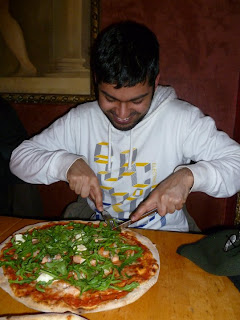
Full of food, we went home.
Sunday - a taxi cost us about €35 from central Berlin to Schoenfeld airport around 9am in the morning, took less than 30 minutes. Our flight was delayed, but we arrived in Luton Airport. From there, our prebooked EasyBus ticket (£2 online) got us back to central London, we decided to get off at Baker street to get the tube home.
Overall: Berlin is a nice city, full of friendly and helpful people. I was rather worried as a muslim about where we would eat. We did not spot any halal restaurants other than in the mosque which served a v basic meal, but there were plenty of fish or vegetarian options so it was fine. We managed on a budget of about €15 a meal. In terms of things to do , I would rate it lower than Lisbon or Barcelona or Paris. It didn't help that the weather was absolutely freezing even in early March. The underground U and S Bahn are easy to use, and not too expensive.
Thought I would give a summary of a trip to Berlin.
Thursday:
Three of us took an Ryanair flight from London Stansted to Schoenfeld airport. We randomly met a British guy on the flight who happened to be a Segway tour guide for Berlin, who advised that we take the 171 bus (driver sold us a ticket for €3 that lets you use all public transport for the next 2 hours) to Rudow station, and then used the U and S bahn system to get to our destination - Wittenbergplatz. From there we found our hotel - Holiday Inn - which was charging about £25 a night per person for sharing a double room of decent quality with buffet breakfast included. We finished checking in around 11:30pm, by which point we were so hungry but almost everything was closed so opted for vegetarian burgers at McDonalds (€1 a burger!).
The next morning we returned to Wittenbergplatz and bought a 2 day Berlin Welcome card for €16. These cards give you unlimited use of public transport and discounts on various tourist entry fees, and seem to be easy to use - you can get them for different numbers of days for different zones (most tourist stuff is in zones A and B, you won't need zone C except to get back to schonefeld airport). What we did not realise was that the 2 day card did NOT include what we thought it did, which was the free pass to Museum Island. For that, you need to spend about €34 for the 3 day card. You need to validate the card the first time you use it - look for little free standing machines near station entrances where you feed the ticket in to get it stamped in the appropriate square. These cards come with a guide book as well.
We then explored the area, inluding the Kurfurstendamm road, and entered the Story of Berlin museum (getting a 25% discount with our Berlin card). It's a nice overview of Berlin's history but it is a bit overwhelming - there is a little bit TOO much text to read. Unfortunately the tour of the nuclear bunker requires a guide, and the one in English was at 12pm. Since we wanted to get going by 11am, we decided to not hang around for it.

Afterwards we headed for Potsdammer Platz (where my friends paid several € to have their passports stamped with apparently authentic stamps showing they had passed through what used to be west and east berlin) and then to the Holocaust Memorial. We did not enter the museum underground but just saw the outside - the memorial is stark, composed of blocks of stone, almost like a graveyard.

Nearby was the Brandenburg Tor (gate) and the square which is a nice place to take your tourist photos, and where we met our friend who joined us, so now we were 4.
From there, 3 of us attempted to find a mosque for Friday Prayers. Now we DID research where to go before we came to Berlin - unfortunately no one thought to bring that research with them! We did eventually find a new Turkish mosque, right opposite Gorlitzer Bahnhof on the U-bahn, sort of on Wiener Strasse road. They serve food in the basement level (€3.50 for a yummy meatwrap + drink). Sadly we got there a little too late for the Jummu'ah prayers but we did speak to a very friendly man who kept us company while we ate lunch, who apparently learnt to speak English from watching Oprah Winfrey shows.
We had left our non muslim friend to wait at the Topography of Terror, which is not the most imaginatively designed museum - it's basically a very large room with lots of displays, information plaques and photos, but it does tell the very grim story of just how brutal the Nazi regime was and how they methodically and brutally destroyed Jews, gypsies, homosexuals and any other people they decided did not deserve to live along the Master Race.
From there we went past Checkpoint Charlie, the infamous crossing point between the east and west, and skipped the museum (would have been €9 with our Berlin card). We saw AlexanderPlatz (a large public square). Nearby is the impressive TV Tower, the largest structure in Berlin (apparently there is a revolving restaurant at the top).
We then headed for Museum Island, where several large museums are located.
We opted for the biggest and most famous, the Pergamon, named after the main feature taken from the eponymous Greek temple. There are several impressive rebuilt temple structures, and rebuilt walls taken from Babylon. Was v tiring getting through it all. We spent about €12 a ticket since we did NOT have the benefit of the museum card in our Welcome Berlin card.
Exhausted from that, we managed to bump into the man from the Easyjet flight, who suggested a place to eat. We went (I think!) to Frankfurter Tor station and then wandered about along Frankfurter Allee for a while looking for the restaurant he recommended (there are quite a few in the area). Eventually by chance, not his directions, we found it - a decent thai restaurant called Lemongrass which I think is near a side street called Niederbarnimstrasse.
(http://www.tripadvisor.com/ShowUserReviews-g187323-d1343118-r95213435-Lemongrass-Berlin.html).
It was quite reasonable price, tasty food (and suitable for non-meat eaters such as muslims who cant find halal meat, or hindus).
Saturday:
First we went to find the nearby Kaiser Wilhelm cathedral which was destroyed in World War 2 and rebuilt. We couldn't find it - because it is hidden under scaffolding! But what is left is very beautiful, and the replacement is also serene and beautiful inside, if somewhat plain and functional on the outside. The old cathedral contains an iron cross from Coventry, exchanged in partnership to underline how the Germans and British inflicted so much pain and destruction upon one another, and hopefully we will never see that done again.
We went to see the Reichstag, which houses the German parliament the Bundestag, where we queued in the freezing weather for almost half an hour before finding out that unless you book a week in advance to have security checks, you will NOT be allowed in! This is a recent development so wasn't in any online review or guidebook we read :(
Frozen to the bone, we walked to the Brandenburg Tor again, and saw a sign for a vegetarian restaurant which was apparently 600m away. There is a little cluster of restaurants and shops behind the Holocaust Memorial, and behind that is the vegetarian Thai restaurant, Samadhi. Food was very tasty, portions were ok, had a main course and ginger tea (to soothe my throat after standing outside in the freezing cold) for about €15.
After that we wandered around different areas like the Karl Marx forum and the Gendarmenmarkt, and eventually made it to the DDR museum which is near the Berliner Dom cathedral. It's an interactive museum all about East Berlin under soviet rule, and cost about €8 to get in (we didn't realise we could have saved €2 with our Berlin card). There are lots of displays, cabinets, cars to sit in, an interrogation room, touchscreen games etc.
We decided to avoid any more museums after that. For some crazy reason we went all the way to the Olympic stadium, which was creepy as it was pitch black when we go there, and there was a car parked with two guys sitting in it, doing.... nothing, it seemed. We took some pictures and then headed back to town. We went to Savignyplatz station, where there are many restaurants, and opted for Apostles, which serves some rather LARGE pizzas for about €12 each.

Full of food, we went home.
Sunday - a taxi cost us about €35 from central Berlin to Schoenfeld airport around 9am in the morning, took less than 30 minutes. Our flight was delayed, but we arrived in Luton Airport. From there, our prebooked EasyBus ticket (£2 online) got us back to central London, we decided to get off at Baker street to get the tube home.
Overall: Berlin is a nice city, full of friendly and helpful people. I was rather worried as a muslim about where we would eat. We did not spot any halal restaurants other than in the mosque which served a v basic meal, but there were plenty of fish or vegetarian options so it was fine. We managed on a budget of about €15 a meal. In terms of things to do , I would rate it lower than Lisbon or Barcelona or Paris. It didn't help that the weather was absolutely freezing even in early March. The underground U and S Bahn are easy to use, and not too expensive.
Thursday, 30 December 2010
How to finish your PhD
I;ve been busy! I went on holiday at long last to Lisbon, and I revised for my PhD viva, passed it, corrected my thesis and handed it in to complete my PhD!
Here is what I wrote on 43 things for completing my PhD (the only task on there i have actually noted as finished)
I started my PhD in 2004 in a research lab. At the start of my second year, I was gobsmacked to find out my supervisor was leaving to set up a new lab somewhere else in a different city in the UK. This was after he had JUST recruited a new Post Doctoral worker from Australia and a PhD student from Portugal. In fact, when I started, he already knew he was planning to leave, but neglected to inform me.
We were given the options of either moving with him or being left to fend for ourselves. At this point my project was not going well (as is very common for middle of phd) and ever worse, my relationship with my supervisor was poor. I found it difficult to talk to him.
I spoke with the student advisor, who suggested I wait until my midterm before making a decision. The midterm is half way through the phd, where you switch from an MPhil (Masters) to a full PhD program. I passed the midterm viva, and decided I did not want to move with my supervisor. In fact, no one from our lab did. Lab heads do move their labs, and usually at least half the lab moves with them. Unsurprisingly, none of us wanted to go with our supervisor, given his mercurial moods and unpleasant manner.
So I was left looking for somewhere to go. I was told that I could start afresh somewhere else, with new funding, but all my previous work would be discarded and would not count towards the new project. This was quite a shock, but I looked around. Unfortunately there was nowhere available – any lab who really wanted a new student had already filled up their lab space with incoming students for 2006. Luckily, one lab head gave me a place. So i started afresh in September 2006.
The project I was given – generating knockout mice. Now, anyone who works in this field will be able to tell you that it is a LOT of work, and hardly suitable for a PhD student, especially one in a lab which has NO experience in this sort of work. I foolishly agreed to the project, and so began 4 very stressful years. The mouse project did not work, and the second project was equally stressful, although I scraped some results in the end. My thesis was not the most exciting, but somehow I managed to put enough data together to fill it up (there was a bit of barrel scraping in some instances).
Even more fun was the fact that I had 3 years funding for a 4 year project. So I spent the last year relying on savings and my parents. My supervisor did nothing to help me find money. I am now very poor!
My advice?
If you are about to start a PhD – think VERY seriously about it! It really eats into your social life. I have lost count of how many times I didn’t go out with friends or family, how many times I was in the lab all day saturday, sunday and then back to work monday as normal. Also, trust your gut instinct regarding the supervisor. You have to work with him/her for 4 years! Make sure you insist on speaking with people in the lab.
If you are in the middle of the phd – keep your bibliography up to date! And make sure EVERY result you get is written up as if it is going to be in your thesis. You may think its rubbish and never going to see the light of day, but if you get to the end and have nothing exciting, you’ll end up going through rubbish old results just to find stuff to fill the thesis up!
Make sure you don’t get stuck on projects that seem to be going nowhere. If you have tried every alternative and optimised the method, think about where to go next, don’t just keep plodding on and banging your head against the wall. Quite often, supervisors are happy to cling to stupid methods/ideas, you may have to jump to something new which they won’t like, but it is YOUR phd, not theirs, and you;re the one who has to answer for it at the viva.
The viva itself was not that bad, at 3 hours long. I think I was probably quite lucky and got sensible examiners. They did ask a few questions which I couldn’t really answer, despite my best guesses, but I admitted I didn’t really know, and they accepted that.
I got a list of corrections to do, which i did within less than 2 weeks. I then printed my final thesis (in a nice hardback edition) and handed in copies to the lab and the university, and kept one for myself.
You may think you are never going to get through this. The last 2 years of my phd, I thought it was a prison sentence. I was literally counting down the days to freedom. So many times I fantasised about running away, or writing a resignation letter. My secondary supervisor was perfect for offering the moral support and shoulder to cry on that my primary supervisor was never going to give. My family did their bit too. Finishing the phd is a matter of endurance and taking the pain, but don’t let the frustration cloud your judgement. Make sure you discuss your work as often as possible with as many different people as possible (ensuring they aren’t people who might want to steal it) to see if others have interesting insights, or think your ideas are plain nuts :)
Good luck
Here is what I wrote on 43 things for completing my PhD (the only task on there i have actually noted as finished)
I started my PhD in 2004 in a research lab. At the start of my second year, I was gobsmacked to find out my supervisor was leaving to set up a new lab somewhere else in a different city in the UK. This was after he had JUST recruited a new Post Doctoral worker from Australia and a PhD student from Portugal. In fact, when I started, he already knew he was planning to leave, but neglected to inform me.
We were given the options of either moving with him or being left to fend for ourselves. At this point my project was not going well (as is very common for middle of phd) and ever worse, my relationship with my supervisor was poor. I found it difficult to talk to him.
I spoke with the student advisor, who suggested I wait until my midterm before making a decision. The midterm is half way through the phd, where you switch from an MPhil (Masters) to a full PhD program. I passed the midterm viva, and decided I did not want to move with my supervisor. In fact, no one from our lab did. Lab heads do move their labs, and usually at least half the lab moves with them. Unsurprisingly, none of us wanted to go with our supervisor, given his mercurial moods and unpleasant manner.
So I was left looking for somewhere to go. I was told that I could start afresh somewhere else, with new funding, but all my previous work would be discarded and would not count towards the new project. This was quite a shock, but I looked around. Unfortunately there was nowhere available – any lab who really wanted a new student had already filled up their lab space with incoming students for 2006. Luckily, one lab head gave me a place. So i started afresh in September 2006.
The project I was given – generating knockout mice. Now, anyone who works in this field will be able to tell you that it is a LOT of work, and hardly suitable for a PhD student, especially one in a lab which has NO experience in this sort of work. I foolishly agreed to the project, and so began 4 very stressful years. The mouse project did not work, and the second project was equally stressful, although I scraped some results in the end. My thesis was not the most exciting, but somehow I managed to put enough data together to fill it up (there was a bit of barrel scraping in some instances).
Even more fun was the fact that I had 3 years funding for a 4 year project. So I spent the last year relying on savings and my parents. My supervisor did nothing to help me find money. I am now very poor!
My advice?
If you are about to start a PhD – think VERY seriously about it! It really eats into your social life. I have lost count of how many times I didn’t go out with friends or family, how many times I was in the lab all day saturday, sunday and then back to work monday as normal. Also, trust your gut instinct regarding the supervisor. You have to work with him/her for 4 years! Make sure you insist on speaking with people in the lab.
If you are in the middle of the phd – keep your bibliography up to date! And make sure EVERY result you get is written up as if it is going to be in your thesis. You may think its rubbish and never going to see the light of day, but if you get to the end and have nothing exciting, you’ll end up going through rubbish old results just to find stuff to fill the thesis up!
Make sure you don’t get stuck on projects that seem to be going nowhere. If you have tried every alternative and optimised the method, think about where to go next, don’t just keep plodding on and banging your head against the wall. Quite often, supervisors are happy to cling to stupid methods/ideas, you may have to jump to something new which they won’t like, but it is YOUR phd, not theirs, and you;re the one who has to answer for it at the viva.
The viva itself was not that bad, at 3 hours long. I think I was probably quite lucky and got sensible examiners. They did ask a few questions which I couldn’t really answer, despite my best guesses, but I admitted I didn’t really know, and they accepted that.
I got a list of corrections to do, which i did within less than 2 weeks. I then printed my final thesis (in a nice hardback edition) and handed in copies to the lab and the university, and kept one for myself.
You may think you are never going to get through this. The last 2 years of my phd, I thought it was a prison sentence. I was literally counting down the days to freedom. So many times I fantasised about running away, or writing a resignation letter. My secondary supervisor was perfect for offering the moral support and shoulder to cry on that my primary supervisor was never going to give. My family did their bit too. Finishing the phd is a matter of endurance and taking the pain, but don’t let the frustration cloud your judgement. Make sure you discuss your work as often as possible with as many different people as possible (ensuring they aren’t people who might want to steal it) to see if others have interesting insights, or think your ideas are plain nuts :)
Good luck
Monday, 27 September 2010
What an amazing few days


Firstly, Eid Mubarak! The holy month of Ramadhan ended, and virtually everyone seems to have celebrated Eid-ul-Fitr, the festival of the fast breaking, on the same day (since the Islamic calendar relies on a lunar calendar and on people sighting the new moon, people can disagree on whether the new month has started or not).
On that same day, I decided to go into work and hand in my thesis! I paid extra to have it bound more quickly. They look awesome. I can't express how happy I am to get to this stage. Even if I fail my viva, at least I got here and submitted something!. Now all I have to do is wait for my examiners to read my 200 page thesis before we decide on an examination date so we can meet and they can spend 2-5 hours tearing it to shreds and reducing me to tears. In Ukraine, PhD examinations are in public, with the institute and your friends and family as audience members!
Now that I am a man of leisure, I decided to... go back to work for one last experiment, which gave good results. It was an expression construct I had made, basically a piece of DNA to make cells create a protein they wouldn't normally make. It works, so maybe my lab can use it after I leave in future experiments! Other than that, I have been enjoying myself at last. I ordered a new Xbox 360 slim from the Microsoft store which went missing so I got fed up and got a refund, and got an xbox bundle from HMV instead. They delivered the xbox and game fairly quickly, but still haven't delivered the second game, 3 weeks later. The new xbox is awesome. It is a lot smaller than previous models. It DOES still get rather hot, which is worrying. At least the fan is a lot more quiet. With its impressive 250GB hard drive, I have started saving games to the hard drive, so that the machine doesn't have to work as hard and there is reduced risk of scratching the game disc. So far I have been replaying Mass Effect 2 on Hardcore.
I also attended the Lost Marathon at the Prince Charles Cinema. They decided to show all 120 hours worth of six seasons of the show Lost, back to back. I got there on Monday at 8am, expecting a huge queue of people. The queue consisted of about 10 people waiting forlornly. I was on my own so just struck up conversation with some of them. Nerds are good at making friends with each other :) In the end only about 50 or so people went in. I didn't think I would get in and had only planned to stay a few hours. I nonetheless stayed for 24 hours, which took me through season one and into the first 3 episodes of season two. Seeing Lost on the big screen was incredible. I have never really rewatched any of the episodes, so I had forgotten a lot of season one events. It really struck me just how brutal and harsh their life was on the island! The cinema showed the episodes in 4 hour blocks, with 15 minute breaks. I had no change of clothes, and no sleeping bag. I decided I would go mad if I stayed there longer so I left. I nonetheless got a goody bag, consisting of Season 6 DVD set, a poster, a tshirt and an Artifacts booklet with snippets from the upcoming Encyclopedia. I almost wish I had stayed until The End on Friday morning, but I think I would have become as deranged as Claire by that point.
Thursday, 26 August 2010
Ramadhan - half way finished
Whew. We're now past the halfway mark on the holy month of Ramadhan. Each year, muslims spend a month fasting, abstaining from food, drink, smoking or intake of anything else during the sunlit hours of the day. This year the fasts have roughly been around 3am - 8pm. Tough, but not impossible. It's more the disrupted sleeping routine thats wearing me down than the food and water ban. Trying to finish my phd is not helping matters. Tomorrow is my last day of major lab work. After that, its just writing and rewriting. My thesis is actually taking shape, its unbelievable. I never thought I'd see this day.
THe downside is that so much time at work = no time spent in contemplation. Muslims typically spend much of Ramadhan in prayer, especially at the mosque in extended evening prayers called taraweeh. Unfortunately I've only been twice so far. I have really neglected my spiritual needs, but soon my thesis will be handed in, and I can reclaim my life and make up for it.
THe downside is that so much time at work = no time spent in contemplation. Muslims typically spend much of Ramadhan in prayer, especially at the mosque in extended evening prayers called taraweeh. Unfortunately I've only been twice so far. I have really neglected my spiritual needs, but soon my thesis will be handed in, and I can reclaim my life and make up for it.
Tuesday, 3 August 2010
iPod Touch apps
I have to admit, I haven't really taken full advantage of my iPod Touch or my new Android HTC phone. There are so many apps available from iTunes and the Android Store, but most of them seem to be rather useless! In particular for the ipod, many of them work best if internet connectivity is available. Since it's not an iPhone, it only connects when I'm at home.
I have however invested in several apps for the iPod Touch.
1) Sol free. It has several card games based on solitaire. Free Recommended.
2) Civilisation Revolutions. I only played the original Civilisation games occasionally on friends' PCs so I had a passing familiarity with the game. This version generates a random world map, and lets you control various forces to create an empire. Initially you start off with one settler, who founds a city. You began researching technology like pottery, writing, combustion, electronics and atomic energy to allow you to progress. You make granaries, temples, and workshops to help you make soldiers, planes and nuclear weapons to dominate the world. Along the way you can make Wonders of the World for bonuses. You can win in several ways - create the most advanced nation, or wipe out the other AI-controlled nations before they eliminate you. Some of the touchscreen controls can irritate at times, but its an immensely addictive game! Costs £3.99 Recommended.
3) iFitness. A decent workout programme. It contains a wide range of different weight lifting exercises, most of which come with not just pictures and text but short demonstrative video clips as well. You can record your workouts with reps and sets, and monitor your body measurements and weight, all of which are presented in little graphs to show your progress. £1.19 Recommended
4) Stanza. ebook reader. I've only used it to download the free books, which are mostly the classics. So the Brothers Karamazov, or Ulysses, or Art of War, or Jekyll and Hyde. The text is not too difficult to read and is quite handy for the bus or train. free Recommended
5) Prayer times. Gives you times for salaat, direction of Qibla etc. Needs an internet connection to keep up to date. £0.59 Recommended
6) Lux touch. Basically Risk on ipod! It is incredibly addictive (sound effects are annoying, so I play with the sound off). Just like the board game, you are assigned countries randomly (and your soldiers are allocated randomly to those countries). Then you have to wipe out all the AI controlled empires by conquering the world. The more countries you control, the more recruits you get each turn. Each time you conquer a country you get a bonus which cashes in when you have 3 bonuses (this aspect was rather odd, as the bonus can be anywhere from 30-200 soldiers). The 4 AI characters have distinct ways of playing (red is always v methodical, yellow is brash and expends all forces to attack anyone and everyone), but there are odd behaviours (quite often they seem reluctant to entirely eliminate an AI, preferring to leave them at least one country). free Recommended
7) Plants vs zombies. A defence tower game. You have a lawn. Zombies start on one end and attempt to cross to reach your house on the other end. You must put various plants in their way. Pea plants shoot peas to kill zombies, sunflowers generate solar energy to pay for plants, red chilli wipes out all zombies in one direction etc. There are then variations on this - the back garden has a pool which requires lilypads to help your plants float; attacks at night require mushroom plants which can thrive without the sun; attacks via the roof rely on potted plants. There are various types of zombies too - some have helmets for added protection, other can pole vaunt over your defences, while the Ogre zombie just smashes through everything, and dolphin zombies can bypass your defences in pools. Yes, really! Great soundtrack too £1.59 Recommended
8) Air sharing. For sharing files, making your ipod a proper harddrive. Lets you store word pdf and video files, without having to use other apps to view them. So you can view videos that might not be compatible with iTunes, since it connects your ipod directly to your computer wirelessly. £1.79
9) Hearts free. For playing Hearts card game. Addictive and infuriating when you get the queen of spades! Free. Recommended
10) Monkey Island. The original classic touch and point game. You control Guybrush Threepwood. You can get him to talk to characters, pick up objects, and use objects on people or locations. It requires a lot of patience and effort to get the right actions in the right order - quite often defying logic as to how to solve each problem. There is a hint advisor that can help you past rather confusing or tricky parts. The maps are ridiculously tiny - at one point I was stuck and had to resort to online cheating for answers, simply because I hadn't located something on the map as it was so difficult and obscured. £4.99 Recommended
11) Oregon trail. Not nearly as fun as it sounded. You control a family in the 1800s on the US frontier. You have to get from one end of the US to the other, all the while doing tasks like fishing, picking berries or hunting animals (simple touch screen games requiring certain number of items scored under time). It gets v repetitive and boring after a while, and the little facts given out become tiresome. £2.99
12) Spider. Initially I found this remarkably boring, but it soon grew on me. You control a spider which has to eat all the bugs in each room. You have a limited amount of webbing which you can use to spin webs to catch bugs, but catching and eating prey replenishes your spidersilk. If you catch the minimum amount, a portal opens to lead to the next level. If you find all the items and eat everything, you score bonus points. The music track is rather catchy too. £0.59 Recommended
13) Uniwar. Not as fun as it looked. You make robot warriors of different types and have to blow up the opponent's forces before they get you. £0.59
14) Beneath A steel sky. Just like Monkey Island, although the puzzles are a lot more logical and easier to understand how to solve for the most part. Set in a dystopian future, the English accents are rather jarring. Your character is kidnapped from the gypsy life and brought to the city under control of an evil computer intelligence. You must figure out why. Like Monkey island, you have to get your character through the game by talking to characters and picking up and using objects in the right place at the right time. Some of it is funny, some of it actually rather creepy. The original game is rather old, from the 80s. £1.79 Recommended.
I have however invested in several apps for the iPod Touch.
1) Sol free. It has several card games based on solitaire. Free Recommended.
2) Civilisation Revolutions. I only played the original Civilisation games occasionally on friends' PCs so I had a passing familiarity with the game. This version generates a random world map, and lets you control various forces to create an empire. Initially you start off with one settler, who founds a city. You began researching technology like pottery, writing, combustion, electronics and atomic energy to allow you to progress. You make granaries, temples, and workshops to help you make soldiers, planes and nuclear weapons to dominate the world. Along the way you can make Wonders of the World for bonuses. You can win in several ways - create the most advanced nation, or wipe out the other AI-controlled nations before they eliminate you. Some of the touchscreen controls can irritate at times, but its an immensely addictive game! Costs £3.99 Recommended.
3) iFitness. A decent workout programme. It contains a wide range of different weight lifting exercises, most of which come with not just pictures and text but short demonstrative video clips as well. You can record your workouts with reps and sets, and monitor your body measurements and weight, all of which are presented in little graphs to show your progress. £1.19 Recommended
4) Stanza. ebook reader. I've only used it to download the free books, which are mostly the classics. So the Brothers Karamazov, or Ulysses, or Art of War, or Jekyll and Hyde. The text is not too difficult to read and is quite handy for the bus or train. free Recommended
5) Prayer times. Gives you times for salaat, direction of Qibla etc. Needs an internet connection to keep up to date. £0.59 Recommended
6) Lux touch. Basically Risk on ipod! It is incredibly addictive (sound effects are annoying, so I play with the sound off). Just like the board game, you are assigned countries randomly (and your soldiers are allocated randomly to those countries). Then you have to wipe out all the AI controlled empires by conquering the world. The more countries you control, the more recruits you get each turn. Each time you conquer a country you get a bonus which cashes in when you have 3 bonuses (this aspect was rather odd, as the bonus can be anywhere from 30-200 soldiers). The 4 AI characters have distinct ways of playing (red is always v methodical, yellow is brash and expends all forces to attack anyone and everyone), but there are odd behaviours (quite often they seem reluctant to entirely eliminate an AI, preferring to leave them at least one country). free Recommended
7) Plants vs zombies. A defence tower game. You have a lawn. Zombies start on one end and attempt to cross to reach your house on the other end. You must put various plants in their way. Pea plants shoot peas to kill zombies, sunflowers generate solar energy to pay for plants, red chilli wipes out all zombies in one direction etc. There are then variations on this - the back garden has a pool which requires lilypads to help your plants float; attacks at night require mushroom plants which can thrive without the sun; attacks via the roof rely on potted plants. There are various types of zombies too - some have helmets for added protection, other can pole vaunt over your defences, while the Ogre zombie just smashes through everything, and dolphin zombies can bypass your defences in pools. Yes, really! Great soundtrack too £1.59 Recommended
8) Air sharing. For sharing files, making your ipod a proper harddrive. Lets you store word pdf and video files, without having to use other apps to view them. So you can view videos that might not be compatible with iTunes, since it connects your ipod directly to your computer wirelessly. £1.79
9) Hearts free. For playing Hearts card game. Addictive and infuriating when you get the queen of spades! Free. Recommended
10) Monkey Island. The original classic touch and point game. You control Guybrush Threepwood. You can get him to talk to characters, pick up objects, and use objects on people or locations. It requires a lot of patience and effort to get the right actions in the right order - quite often defying logic as to how to solve each problem. There is a hint advisor that can help you past rather confusing or tricky parts. The maps are ridiculously tiny - at one point I was stuck and had to resort to online cheating for answers, simply because I hadn't located something on the map as it was so difficult and obscured. £4.99 Recommended
11) Oregon trail. Not nearly as fun as it sounded. You control a family in the 1800s on the US frontier. You have to get from one end of the US to the other, all the while doing tasks like fishing, picking berries or hunting animals (simple touch screen games requiring certain number of items scored under time). It gets v repetitive and boring after a while, and the little facts given out become tiresome. £2.99
12) Spider. Initially I found this remarkably boring, but it soon grew on me. You control a spider which has to eat all the bugs in each room. You have a limited amount of webbing which you can use to spin webs to catch bugs, but catching and eating prey replenishes your spidersilk. If you catch the minimum amount, a portal opens to lead to the next level. If you find all the items and eat everything, you score bonus points. The music track is rather catchy too. £0.59 Recommended
13) Uniwar. Not as fun as it looked. You make robot warriors of different types and have to blow up the opponent's forces before they get you. £0.59
14) Beneath A steel sky. Just like Monkey Island, although the puzzles are a lot more logical and easier to understand how to solve for the most part. Set in a dystopian future, the English accents are rather jarring. Your character is kidnapped from the gypsy life and brought to the city under control of an evil computer intelligence. You must figure out why. Like Monkey island, you have to get your character through the game by talking to characters and picking up and using objects in the right place at the right time. Some of it is funny, some of it actually rather creepy. The original game is rather old, from the 80s. £1.79 Recommended.
Subscribe to:
Posts (Atom)